
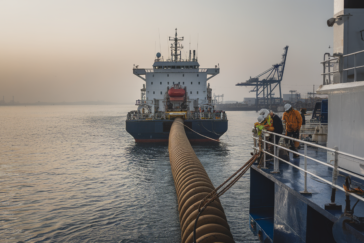
The world’s largest undersea cable project, built to shove massive amounts of data between Africa and Asia, has slammed the brakes in the Persian Gulf right as crews were heading into the home stretch.
And no, this isn’t some nerdy construction hiccup happening in the middle of nowhere. The Gulf is a cramped, high-stakes bathtub packed with oil and gas infrastructure, shipping lanes, and governments that don’t love surprises on their seabed.
On paper, laying a cable sounds simple: drop it on the ocean floor and call it a day. In real life, every mile is permits, security clearances, environmental rules, and “sovereignty” conversations that can turn a schedule into confetti.
A mega cable meant to stitch Africa to Asia, until the Gulf said “hold up”
The project is being billed (by the people selling it) as the biggest undersea cable system on Earth in scope and ambition: a high-capacity link between Africa and Asia, with branches to other regions. Think of it less like a single wire and more like a sprawling interstate system under water, with multiple off-ramps, “landing stations”, feeding different countries.
The pitch has two parts. First:capacity, because cloud computing, video, corporate data traffic, and cross-border everything keep ballooning. Second:redundancy, because when one route breaks, you want another one ready.
And yes, the industry’s favorite stat shows up here for a reason: undersea cables carry roughly95%of international data traffic (the exact number varies depending on how you count). Satellites are great for some uses and as backup, but they don’t haul the same volumes as fiber.
But the bigger the project, the bigger the target, and the longer the route, the more political tripwires it crosses. Africa-to-Asia connectivity is especially touchy because it’s part of a broader push to route data without always bouncing through Europe’s traditional hubs.
So when the final work in the Persian Gulf gets paused, with no public restart date, customers who were planning to buy capacity can’t exactly pencil in a launch window. And the local authorities? They’re playing a different game: control, security, environmental conditions, and the economics of who gets to host the landing points.
Why a pause in the Persian Gulf can blow up the whole timeline
The Persian Gulf stacks headaches like it’s trying to set a record. Shipping traffic is dense. Oil and gas terminals are everywhere. Rules are strict. And near shore, cables often have to beburiedin the seabed for protection, because anchors and fishing gear are cable-killers.
Late-stage work is also the least forgiving. “Closing” a route can mean finishing a segment, tying into a landing station, running optical continuity tests, and adding protective measures. If you stop there, you’re not just delaying, you’re parking extremely expensive specialized ships and engineering teams.
In the cable world, a single day for a cable-laying vessel can runtens of thousands of euros. Call ittens of thousands of dollars per dayas a rough American translation, and sometimes more depending on availability and complexity. That meter keeps running even when the lawyers and regulators are arguing.
Then there’s the obvious: the Gulf is a sovereignty minefield. Even if the cable is “international,” the landing is local. A permit gets paused, a security doctrine changes, or a government asks for extra guarantees, and suddenly the project schedule belongs to someone else.
Environmental restrictions can also bite, seasonal limits, impact studies, protected habitats, fishing zones. Sometimes the reason for a stop never gets aired publicly, because nobody wants to advertise what they’re worried about.
And geographically, the Gulf is a bottleneck. You can route around trouble, but detours mean longer cable, higher costs, and worse latency. For a system designed to connect continents, losing time in a choke point ripples through the entire commercial rollout.
Undersea cables are “invisible”, until they’re the problem
These cables sit out of sight, but they’re critical infrastructure in the bluntest sense: break enough of them, and economies start coughing.
Damage happens all the time worldwide, anchors, trawling, undersea landslides. Sabotage is the nightmare scenario. Repairs require specialized ships and, in many places, permission to operate in waters that can be politically sensitive or outright disputed. In narrow straits and semi-enclosed seas, vulnerability goes up because routes are concentrated.
Governments have been getting louder about this. Since 2022, NATO and the European Union have repeatedly talked up protecting undersea infrastructure, translation: they’re worried, and they want everyone else to be worried too.
In the Persian Gulf, regional tensions add another layer. Energy infrastructure, shipping, and telecom cables all sit in the same strategic soup. Even if a work stoppage is “technical,” people will read it through a geopolitical lens. Operators tend to keep details vague for security reasons, exact routes and sensitive landing points aren’t something you blast out in a press release.
And when cables get delayed or damaged, the costs aren’t abstract. Data centers, financial markets, e-commerce platforms, and digitized government services depend on international links. Rerouting can mean higher transit costs and degraded performance. Satellites can help in a pinch, but they’re not a fiber substitute for heavy traffic.
What happens next: restart, reroute, or renegotiate
In this business, three outcomes usually show up.
1) Quick restart.The most common: a permit gets sorted, a navigation window opens, a technical method changes. The delay is weeks or a few months, and the extra cost gets eaten by the consortium or pushed into contract renegotiations.
2) Partial reroute.More expensive, more annoying: redraw the segment to avoid the problem area. That means new seabed surveys, new permits, and sometimes new landing points. It can also add distance, which can ding performance, even if modern optical gear can offset some latency.
3) Deeper renegotiation.The spicy one: talks with local authorities shift into sovereignty and security territory, who controls operations, who gets access, where equipment sits, maybe even data-hosting requirements. That’s when a commercial project starts acting like a political dossier, and everyone worries about setting a precedent for other cables.
For the African and Asian markets counting on new capacity, delays have a quiet price tag. Data center investments and terrestrial networks assume reliable international exits. If the schedule slips, operators may have to buy existing capacity that’s often pricier, or route traffic through longer paths via other hubs. That’s a competitiveness tax, even if it doesn’t show up neatly on a balance sheet.
What the industry needs now is basic clarity: when work resumes, what exactly is paused, and whether the route changes. Until then, this stoppage is a reminder that “global connectivity” can get hung up on a few miles of water, and a signature from the right office.