
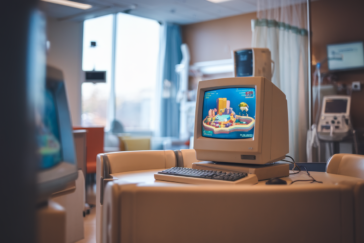
Before Facebook turned your aunt into a political pundit and before “social media” became a job requirement, there was a weirdly wholesome experiment hiding in plain sight: a 3D online world built for kids stuck in hospitals.
It was calledStarbright World. And yes,Steven Spielbergwas attached to it. Not as a cameo, but as a serious booster through theStarbright Foundation, working with the tech outfitWorlds Inc.The pitch was simple and kind of radical for the early ’90s: if a child is going to be in a hospital room for weeks or months, at least give them a place to “go” that isn’t fluorescent-lit misery.
So they built a shared3Dspace where hospitalized kids in different U.S. hospitals could meet up, talk, and play, an early cousin of the social MMO idea, minus the loot boxes and influencer nonsense.
1993: A 3D hangout for kids who couldn’t leave their rooms
The project traces back to1993. Starbright handled the mission and the relationships;Worlds Inc.handled the technical heavy lifting. The goal: connect pediatric patients across hospitals inside a single digital environment.
That doesn’t sound wild now. Back then, it was. Most online interaction was still text-heavy, message boards, closed services, clunky chat. Betting on a3D world with avatarsmeant betting on presence: the feeling that you weren’t just typing into the void, you were actuallysomewherewith other people.
And for kids dealing with long hospital stays, the isolation is its own kind of illness. School friends drift away. Visits are irregular. Group activities get kneecapped by treatment schedules and hygiene rules. Starbright World aimed right at that social rupture: give kids a peer group again, even if it had to travel through a phone line.
This also wasn’t a typical Silicon Valley land-grab. It was a nonprofit-tech partnership, which meant the priorities skewed towardsafety, supervision, and hospital reality, not “growth hacking.”
Spielberg’s name opened doors, but the work was in the trenches
Spielberg is the headline-grabber here, and for good reason. In the early ’90s, having a director of his stature tied to a virtual world for hospitalized kids wasn’t just nice PR, it was jet fuel for credibility. Hospitals, sponsors, administrators: people pick up the phone when that kind of name is involved.
The reporting around the project also points toDavid Marvit, described as an executive producer at Worlds Inc., who met with Spielberg to help move things along. That’s how a lot of socially minded tech got built in that era: a braid of philanthropy, industry, and a famous person who could bulldoze the usual “who are you again?” barriers.
But let’s not turn this into a celebrity fairy tale. A project like this lives or dies on the unglamorous stuff: hospital agreements, hardware installs, maintenance, staff buy-in, rules for kids, rules for adults, and constant vigilance about what happens when you put minors together online.
A social MMO vibe, built for comfort, not clout
Starbright World gets described as an early “social MMO,” and that’s right: multiple users online at once, sharing a persistent space, interacting as more than just usernames in a chat window.
The difference is motive. This wasn’t built to entertain the masses. It was built to help kids claw back a little control, choose where to go, who to talk to, what to do, inside a life otherwise run by IV poles and appointment times.
The 3D element mattered. Text chat lets you talk. A navigable environment lets yougo. For a kid stuck in bed, that’s not a trivial distinction. Even a simple virtual “place” can feel like a break in the walls closing in.
And because this was for children, many of them medically vulnerable, the project had to take moderation and safety seriously. That’s the part early-internet nostalgia tends to skip: if you’re building an online space for minors in hospitals, “anything goes” isn’t a philosophy, it’s a lawsuit waiting to happen.
Why it didn’t turn into the next big platform
People like to frame Starbright World as “before Twitter,” and sure, chronologically it was early. But the real reason it didn’t become a household name is simpler: it wasn’t designed to.
Unlike the social platforms that later swallowed the internet, Starbright World depended onhospital installations, on-site coordination, and equipment that could actually run real-time 3D in the 1990s, when “fast internet” was a punchline and computers varied wildly in capability.
Hospitals also have their own priorities, budgets, and IT/security constraints. Keeping a 3D networked environment running in that setting isn’t like shipping an app update. It’s logistics. It’s support. It’s constant friction.
And then there’s the math of social networks: they thrive on massive scale. Starbright World was intentionally narrow, built for a specific group with limited access. Its success wasn’t “millions of users.” It was whether a kid having a brutal month could laugh with someone who got it.
That’s probably why it faded from the mainstream tech story. It didn’t mint a trillion-dollar company. It just tried to make pediatric wards feel less lonely, using the tools available at the time, plus a little Hollywood horsepower.