
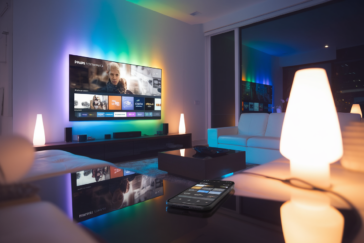
Philips is undoing a mess of its own making.
Three years after it effectively yanked its Ambilight TVs away from the Philips Hue lighting ecosystem, torching one of the whole reasons people paid extra for Ambilight in the first place, the company is restoring compatibility. The twist: it’s doing it throughMatter, the industry’s “everybody play nice” smart-home standard. And because Matter is the point, Philips says this isn’t just a Hue reunion. It also opens the door to other brands, includingIkeasmart lights.
The glue here is something Philips callsAmbiScape, the software layer that lets the TV talk to lights around the room so the colors on-screen spill onto your walls, furniture, and whatever else you’ve got in the splash zone.
Philips broke a fan-favorite feature, and people didn’t forget
Ambilight has always been a simple flex: LEDs on the back of the TV extend the picture beyond the bezel. But for a lot of buyers, the “real” Ambilight experience wasn’t just the built-in glow, it was syncing the whole room with external lights: bulbs, light bars, LED strips.
Then, about three years ago, Philips cut off the straightforward Hue sync path. If you’d already sunk serious money into Hue, still one of the pricier smart-light setups on the market, you weren’t just annoyed. You felt played.
And TVs aren’t phones. People keep them for years. When a headline feature gets worse mid-ownership, that resentment doesn’t fade; it ferments. Philips also had a branding problem: in the public mind, “Philips” and “Hue” are cousins at the same family reunion, even if the corporate reality is more complicated.
AmbiScape is the bridge; Matter is the common language
Here’s the new architecture in plain English: the TV analyzes what’s on-screen, dominant colors, shifts in brightness, scene changes, then sends commands to your lights so the room tracks the image.
AmbiScapeis the conductor.Matteris the sheet music everyone can read.
That matters because smart lighting has been a junk drawer for years: proprietary hubs, half-working integrations, too many apps, too many accounts, and plenty of “supported” devices that behave like they’re doing you a favor. Matter, backed by the Connectivity Standards Alliance, is supposed to reduce that friction by standardizing how devices communicate across brands.
For Philips, this is a practical move: support more lights without cutting a custom deal for every brand and model. For consumers, it’s the promise of fewer dead ends when you mix and match gear.
But let’s not pretend standards magically fix physics. Sync lighting lives or dies on responsiveness. If your bulb lags, the illusion collapses. Matter can help devices talk; it can’t guarantee every bulb reacts fast enough, or that your home network won’t hiccup at the worst moment.
Ikea compatibility changes the money math, and the risk
The most interesting part of Philips’ announcement isn’t “Hue works again.” It’s “Hue isn’t the only option anymore.”
Hue built its reputation on polish: a deep accessory lineup, solid software, and generally reliable performance. It also built it on premium pricing. If Ambilight-style room sync can work credibly withIkealights, typically cheaper and sold everywhere, Philips suddenly has a pitch for people who want the vibe without dropping a small fortune on bulbs.
That’s the upside. The downside is obvious: the more brands you allow into the party, the more uneven the party gets.
A high-end setup can look stunning. A bargain setup might look… fine. And when it looks fine, customers won’t blame the bulb. They’ll blame the TV. Philips is going to need to be crystal clear about requirements, recommended products, and what “compatible” actually delivers in the real world.
The smart-home war is now about updates, not just features
This whole episode is really about trust. Smart-home buyers have learned the hard way that “smart” products are never finished, they’re hostage to updates, security patches, API changes, and corporate mood swings.
When a company removes or degrades a feature after you’ve paid, the product loses value overnight. Matter is supposed to make that kind of arbitrary breakage harder to pull off, or at least harder to justify.
Still, don’t kid yourself: brands will keep proprietary layers to differentiate. And image-synced lighting is an “advanced” feature by definition, it requires tight coordination between video analysis, your network, and the lights themselves. Matter can make the handshake easier; it won’t make every brand’s implementation equally good.
Philips is making a defensive move and an offensive one at the same time: defend Ambilight’s relevance in a TV market where features get copied fast, and attack the price barrier by letting people build a synced-light setup without going all-in on Hue.
The scoreboard will be boring but decisive: how many devices actually work, how stable the sync is (no visible lag), and whether Philips can keep this working through years of software updates without yanking the rug again.
FAQ
What does Matter change for Ambilight TVs?
It gives Ambilight TVs a standardized way, via AmbiScape, to communicate with smart lights across different brands, instead of relying on one closed ecosystem.
Is this only about Philips Hue?
No. Hue compatibility is coming back, but the bigger point is broader support through Matter, including Ikea smart lights.
What makes synced lighting look good (or terrible)?
Low latency, a stable home network, accurate color reproduction, and reliable software updates. If any of those slip, the effect falls apart fast.