
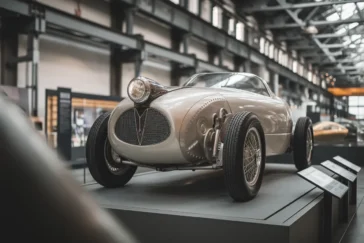
A lot of car “innovation” is just engineers and designers getting high on their own supply.
Over the decades, some genuinely smart people, sometimes at very fancy brands, pitched ideas that sounded like the future and died the moment they met the real world: weight, cost, safety rules, maintenance, and the small problem of whether any sane person would buy the thing.
Here are eight of the best examples of car-world sci‑fi that never made it out of the lab (or the museum), and why.
1) The nuclear-powered car: “5,000 miles per tank” until you remember physics and panic
In the 1950s, when America and Europe were drunk on the “peaceful atom,” the nuclear car wasn’t just a comic-book gag. The pitch was simple: a mini reactor makes heat, heat drives a turbine, turbine turns wheels. Boom, no gas stations, forever.
Some projections tossed around ranges like8,000 km, about5,000 miles, without refueling. And sure, on paper, nuclear energy density makes gasoline look like a candle.
But the killer wasn’t thermodynamics. It wasshielding. Radiation protection is heavy. Like “your car now weighs as much as a small building” heavy. And then comes the part nobody wants to talk about: crashes. Fires. Floods. Tow trucks. First responders. A fender-bender is annoying; a fender-bender with radioactive material is a national incident.
Regulators would’ve had a field day. You’d need tracking, inspections, storage rules, trained handlers, insurance that doesn’t exist, and a political appetite that definitely doesn’t exist. Civil nuclear plants already operate under strict standards, and those don’t move at 70 mph next to a school bus.
In some historical write-ups you’ll see the concept referenced with German labels like“Atomantrieb”. The idea worked great as a symbol of modernity. As a mass-market vehicle? Dead on arrival.
2) A Rolls-Royce with a toilet: luxury meets plumbing, odor, and reality
Luxury carmakers love borrowing cues from long-distance travel, private rail cars, business jets, that whole “your commute is a lounge” fantasy. Somewhere in that universe lives the idea of putting atoiletin a high-end sedan, sometimes linked in retellings toRolls‑Royceas an example of peak excess.
Here’s the problem: a car isn’t a stationary suite. A working onboard toilet needs space, tanks, plumbing, ventilation, and a plan for waste. Every one of those adds weight, eats cabin room, and creates new failure points. And in a vehicle, a “minor leak” isn’t minor, it’s resale value suicide.
Then there’s the unsexy part: service. Even with a closed system, somebody has to maintain it, replace consumables, and dispose of waste properly. That means infrastructure for an option almost nobody uses.
And the biggest issue? The customer. Ultra-wealthy buyers pay for discretion. A toilet in the spec sheet might be practical in rare edge cases, but it clashes with the whole “refined” image. Sometimes the market kills an idea because it feels… tacky.
3) The Cyclops headlight: cool face, bad compliance
A single, central headlight, “Cyclops” style, has popped up in prototypes and design studies for decades. The sales pitch writes itself: one signature light, fewer parts, maybe even a directional beam that points into corners.
But lighting is one of the most regulated parts of a car. Rules cover height, spacing, brightness, beam patterns, and redundancy. A single module concentrates risk: if it fails, you don’t have “one headlight out.” You haveno headlights.
Even performance can be tricky. A central lamp has to handle asymmetric beams, avoid blinding oncoming drivers, light shoulders, and transition cleanly between low and high beams. Directional systems can do it, but they add sensors, motors, calibration headaches, and cost. On older vehicles especially, reliability and price quickly turned the “simple” idea into a mess.
So the Cyclops look often stayed where it belonged: auto-show turntables and limited-run oddities.
4) The fifth wheel: tighter parking, fragile mechanics
The fifth-wheel concept goes after a real pain point: big cars in tight cities. Add a retractable extra wheel, often centered and sometimes steerable, that drops down at low speed to help you pivot, park, or pull tighter turns.
Yes, it can work. But you pay for it in complexity: deployment mechanisms, reinforced structure, load management, sensors to prevent it dropping at the wrong time, and integration with suspension and braking. That’s a lot of hardware living inches from road grime.
Maintenance is where dreams go to die. A retractable wheel sits in the splash zone, water, salt, debris, curb hits. Joints wear. Seals fail. Alignments drift. In a mass-market car, that becomes warranty claims and angry owners.
And for what? Most drivers would use it a few times a week, tops. Carmakers found easier ways: variable steering ratios, rear-wheel steering, and electronic parking assists that don’t bolt a whole extra wheel under the car.
5) Overcomplicated controls: the road punishes “clever”
Not every failed innovation is a nuclear reactor. Plenty of them are just bad ideas on the dashboard.
Car history is littered with bizarre control schemes: overloaded button farms, counterintuitive switch placement, aircraft-inspired interfaces, grouped controls meant to “simplify” driving that actually make basic tasks harder.
Driving runs on muscle memory. If turning on the blinker or adjusting airflow requires a weird sequence, you’re not “modernizing”, you’re distracting the driver. And distraction isn’t a design critique; it’s a crash statistic.
6) Exotic steering and braking layouts: great in a prototype, awful in a used car
Some experimental vehicles tried nontraditional steering or braking controls, multiple levers, consolidated inputs, unconventional layouts. The intent was usually rational: reduce effort, improve precision, look futuristic.
But cars don’t live only with their first owner. They get sold. They get repaired by independent shops. They cross borders. A nonstandard interface becomes a liability when nobody wants to learn it, nobody wants to service it, and the next buyer sees it as “that weird car.”
7) The hidden killer: infrastructure and service networks
Even when a concept is technically feasible, it can still fail because it needs a support system that doesn’t exist. Toilets need servicing. Nuclear fuel needs handling and storage. Specialized mechanisms need trained technicians and stocked parts.
A prototype can dodge those questions. A production car can’t. The minute you scale up, you’re not selling a feature, you’re building an ecosystem.
8) Why these ideas keep failing the same way: cost, rules, and public trust
These flops share a family resemblance because they hit the same walls.
Total cost, not just manufacturing, but training, warranty, insurance, parts, and repairs.Regulations, especially for safety-critical systems like lighting and structure. Andpublic trust, because people buy cars with their fear in mind. Nuclear power in a sedan triggers cultural rejection. A retractable wheel screams “future breakdown.” A toilet in the back seat feels… wrong, even if it works.
The funny part is these failures aren’t useless. They feed patents, internal debates, and sometimes toned-down spinoffs that actually make it to market. But the road has no patience for ideas that ignore maintenance, law, and human behavior.
FAQ
Why do flashy car innovations die before reaching production?Because a cool idea has to survive industrial manufacturing, safety certification, real-world maintenance, insurance, and public acceptance. Many concepts end up too heavy, too expensive, too fragile, or too weird for how people actually drive.