
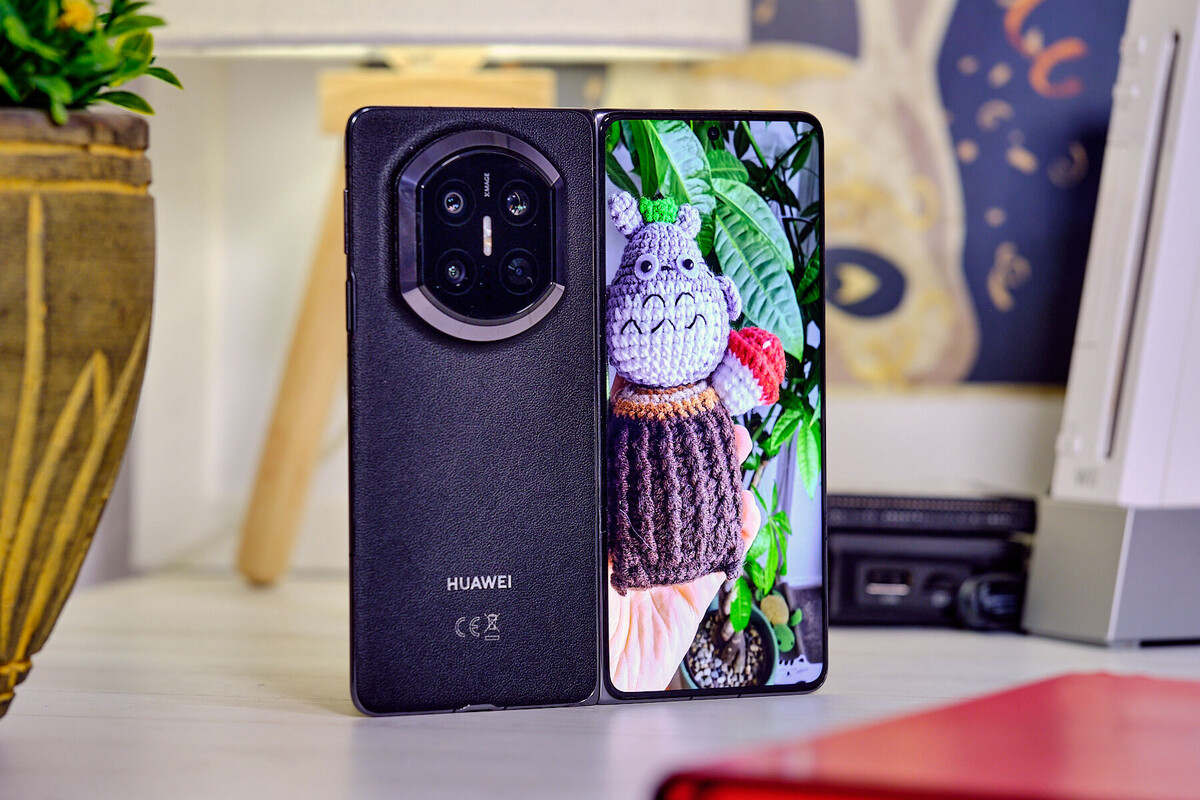
Huawei’s back with another high-end foldable that acts like Google never existed. And annoyingly, it’s good.
The Mate X7 is the company’s latest attempt to sell Europeans (and anyone else who’ll listen) on a premium folding phone that runs day-to-day without Google Play Services—the behind-the-scenes glue that makes a ton of Android apps behave. The pitch is simple: a foldable that finally feels like a “normal” phone, with a camera setup strong enough to make you forget you’re living outside Google’s walled garden.
Hardware-wise, Huawei brought receipts: dual 120Hz displays, up to 3,000 nits of brightness on the outer screen, a 5,300mAh battery, and 66W wired charging. The real flex, though, is the camera—especially a stabilized 3.5x optical telephoto lens. That’s the kind of zoom people actually use, not the fake “100x” nonsense that turns your kid’s soccer game into a watercolor painting.
But the trade-offs are real. Huawei’s Kirin 9030 chip isn’t chasing the top of the benchmark charts, and the Google-free software life demands patience. The question for 2026 is brutally practical: who’s willing to pay premium money for a premium foldable that still asks you to change your routine?
A foldable that finally doesn’t feel like a brick—until you feel the weight
The first thing you notice is the thinness. Closed, the Mate X7 measures 9.5mm. Open, it drops to 4.5mm. In inches, that’s roughly 0.37 inches shut and 0.18 inches open—legit slim for a foldable.
Then you see the camera bump. It’s huge—almost comically thick compared to the rest of the phone—and it changes how the device sits on a table and how it feels in-hand.
And then there’s the weight: 236 grams, about 8.3 ounces. That’s heavier than plenty of regular flagship phones and even heavier than some newer foldables. You’ll notice it in a jacket pocket. You’ll notice it when you’re thumbing through emails one-handed.
Huawei tries to soothe your anxiety with an IP59 rating—dust resistance and protection against strong water jets. That matters because foldables are expensive to fix, and they’re still, by nature, more fragile than a slab phone.
Two sharp 120Hz screens, built for “normal phone” life
The outer display is a 6.49-inch OLED running at 120Hz, with a resolution of 2444 x 1080. Huawei claims up to 3,000 nits of brightness, which—if it holds up in real sunlight—puts it in the “you can actually see your screen outdoors” club.
Inside, you get an 8-inch AMOLED panel, also 120Hz, at 2210 x 2416. Both screens land at 412 pixels per inch, which is the difference between crisp text and that faint “screen door” effect that drives you nuts on big displays.
Huawei also sprinkles in the kind of practical stuff people pretend they don’t care about until it’s gone: a side-mounted fingerprint reader (often more reliable than under-display sensors), dual physical SIM support, and an IR blaster so you can control a TV or air conditioner like it’s 2012 again.
Wi‑Fi 7 and Bluetooth 6.0 are here too, because spec sheets must be fed. The real question is behavioral: are you actually going to unfold an 8-inch screen to answer texts, or is this mostly for reading, work, and photo editing?
No Google: it works… until the wrong app decides it doesn’t
The Mate X7 runs Android 12 with Huawei’s EMUI 15 skin. The headline isn’t the Android version—it’s what’s missing: Google Play Services. That’s the invisible plumbing many apps rely on for logins, notifications, payments, location, and general “please don’t break” stability.
Huawei has its own ecosystem and workarounds, and you can do “almost everything” if you’re willing to adjust your habits. Web browsing, messaging, photos, basic productivity—fine.
Then real life shows up. A banking app that refuses to open. A ride-hailing service that gets flaky. A smart-home app that demands a Google login. And when that happens, it’s never when you’re calmly tinkering at home—it’s when you’re late and your phone needs to behave.
For a device positioned as premium, that’s a tough sell. A high-end phone shouldn’t feel like a science project.
Performance: smooth enough, but not built to bully the competition
Huawei’s Kirin 9030 chip paired with 16GB of RAM keeps the interface feeling fluid. But if you’re a heavy gamer or you push your phone hard—big exports, demanding apps, lots of multitasking—the Mate X7 isn’t trying to be the fastest kid in class.
The comparison Huawei can’t avoid is the mainstream Android world. In the original French piece, the benchmarks are framed against phones like Samsung’s Galaxy S25+ (starting at €899, roughly $980) and Google’s Pixel 9 (starting at €599, roughly $650). The gap isn’t really the screens. It’s the ecosystem and the raw horsepower for heavier workloads.
The camera is the point—and that 3.5x telephoto is the star
Huawei built this phone around photography, and it shows. The rear setup is a triple camera system: a 50MP main camera with variable aperture (f/1.49 to f/4.0) and optical image stabilization, a 40MP ultra-wide, and a 50MP telephoto with 3.5x optical zoom and OIS.
Translation: the zoom is real glass, not a digital crop pretending to be a lens. That matters for portraits and distant subjects—faces don’t get weird, details don’t smear, and you don’t have to walk into traffic to frame a shot.
In everyday use, the telephoto becomes the fun camera. Street scenes without getting in someone’s space. Architectural details. Portraits that don’t warp people’s noses. Huawei also supports high-resolution shooting and RAW for people who actually edit their photos, plus a macro mode that can work better by leaning on the telephoto rather than a dedicated macro lens.
Low light is solid, not supernatural. You’ll still see digital noise in some night scenes, which is basically the tax every smartphone pays after dark. Video performance is consistent with the phone’s premium ambitions. The two 8MP selfie cameras (one outside, one inside) are fine for video calls, but nobody’s buying this thing for selfies.
The real sales pitch is blunt: if you can live without Google, an 8-inch foldable with a legit 3.5x zoom is a pretty tempting way to do it. If you can’t, none of this matters.