
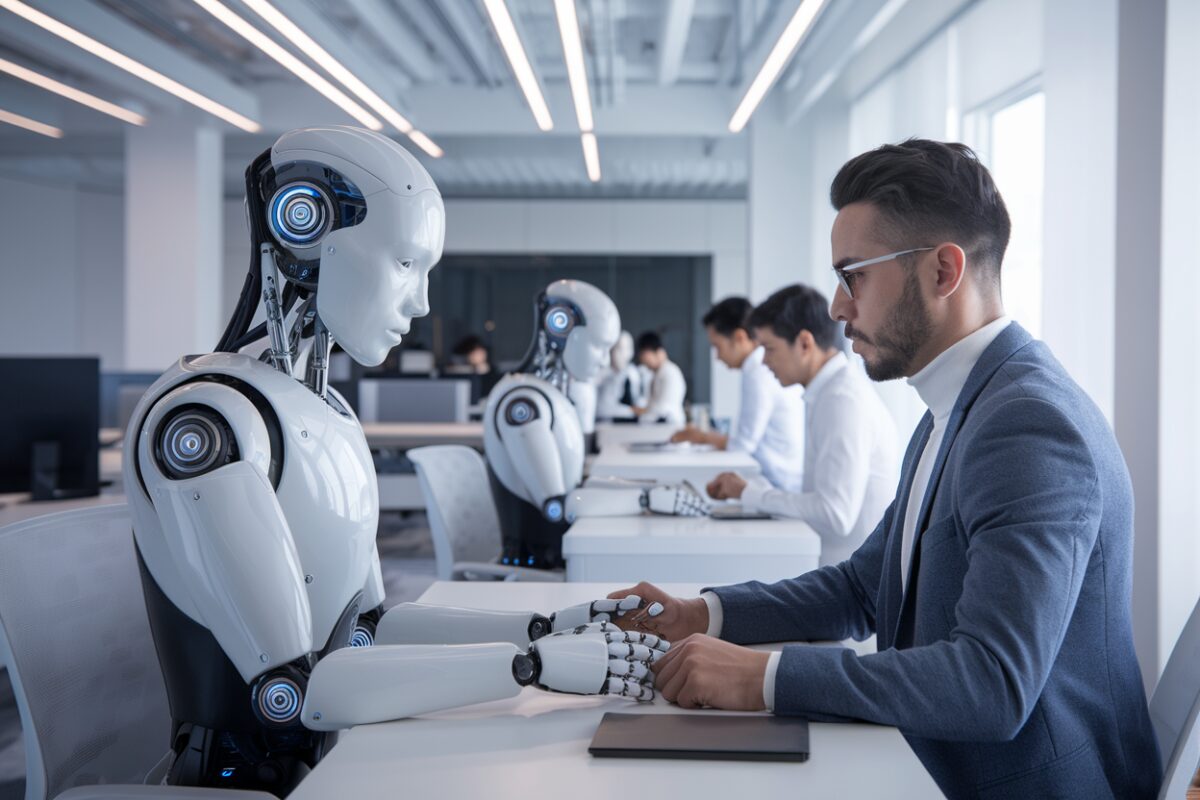
America stands on the brink of a major transformation in its job market. Artificial Intelligence (AI) is no longer just a technological innovation; it’s a central force reshaping millions of jobs. This digital revolution could unlock unprecedented opportunities, but it also raises concerns about job security for millions of Americans. Experts warn that key sectors could be deeply affected, altering the nation’s economic landscape.
The fear of automation isn’t new, but AI adds a new layer of complexity. Unlike past industrial revolutions, AI can replace not only manual tasks but also cognitive functions. This could lead to significant disruptions in areas like healthcare, finance, and even the arts. The pressing question is: how is America preparing for this new economic era?
The Most Vulnerable Sectors
The threat AI poses to employment isn’t evenly distributed across sectors. A McKinsey study suggests that around 800 million jobs could be automated globally by 2030, with the U.S. not spared. Transportation, logistics, and manufacturing are at the forefront. Advanced robotics and AI algorithms are increasingly taking over human workers, especially in repetitive and predictable tasks.
The manufacturing sector, for instance, is already feeling the effects of automation. Companies like Tesla use robots to assemble vehicles, a process once carried out by a large workforce. Similarly, the logistics industry, with giants like Amazon, is adopting automated systems to optimize inventory management and delivery, significantly reducing the demand for human labor.
The service sector is also undergoing a radical transformation. Automated checkouts in supermarkets, chatbots in customer service, and even virtual assistants in healthcare illustrate this trend. While these innovations boost efficiency, they reduce the need for human staff, creating a paradox between technological progress and employment.
Ironically, some professions considered safe from automation are beginning to feel the pressure. Lawyers, accountants, and even journalists—jobs that rely on analytical and writing skills—are seeing some tasks delegated to algorithms and software capable of processing massive data volumes in record time.
Economic and Social Impacts
Beyond the immediate threat to jobs, AI has profound economic and social implications. Economically, automation could boost company productivity and generate significant efficiency gains. However, it might also widen income inequality. Low-skilled workers risk unemployment, while those with IT and AI skills could see their wages rise.
Socially, the replacement of jobs by machines could erode the middle class. The economic ascent that characterized the 20th century might transform into a gap between a tech elite and a majority of precarious workers. This raises questions about social stability and national cohesion, as more citizens might feel left behind in this new economy.
In response, some experts suggest measures like implementing a universal basic income to offset job losses. Others advocate for overhauling the education system to train workers in digital skills essential for the future. Regardless, adjustments will be necessary to avoid disastrous economic and social consequences.
Public policies will also need to evolve to support this transition. Initiatives to encourage innovation while protecting workers will be crucial. Balancing technological progress with social welfare is a complex challenge that policymakers must address in the coming years.
The Evolution of Work: Toward New Skills
As AI continues to advance, the nature of work is evolving. Traditional skills will no longer suffice in a world where automation redefines job roles. Workers will need to adapt by developing technical skills, as well as human skills that remain difficult to automate, such as creativity, critical thinking, and emotional intelligence.
Education and vocational training play a central role in this transition. School programs must be revised to integrate digital skills from an early age. Companies, on their part, must invest in the continuous training of their employees to prepare them for future challenges. This proactive approach will not only mitigate the effects of the transition but also capitalize on the new opportunities it presents.
Moreover, emphasis should be placed on innovation and entrepreneurship. Encouraging tech startups and entrepreneurial initiatives can create new jobs and stimulate economic growth. Supporting small businesses and entrepreneurs is essential to energize the economy and offset job losses in traditional sectors.
Collaboration between the public and private sectors will also be crucial. Governments must work hand in hand with businesses to develop policies that encourage innovation while protecting workers. Public-private partnerships can facilitate the sharing of knowledge and resources, enabling a smoother transition to the future of work.
Ethical and Regulatory Challenges
Beyond economic and social impacts, the rise of AI poses major ethical and regulatory challenges. The question of responsibility is central: who is accountable when AI makes erroneous decisions? Current laws aren’t always suited to these new realities, and it’s crucial to revise them to ensure ethical and responsible AI use.
Privacy protection is another concern. AI algorithms collect and analyze vast amounts of personal data, raising questions about information confidentiality and security. Regulators will need to implement measures to protect citizens against potential abuses.
Finally, it’s essential to ensure that AI doesn’t reproduce or amplify existing biases. AI systems are often trained on historical data, which can lead to unintentional discrimination. Developers and policymakers must work together to create fair and transparent algorithms capable of making just and impartial decisions.
In this context, international collaboration is crucial. AI transcends national borders, and a coordinated approach is necessary to establish global standards and regulations. The U.S., as a technological leader, has a key role to play in defining these standards and promoting ethical and responsible AI on a global scale.
As AI continues to transform the employment landscape, it’s clear that the challenges are numerous. But with a thoughtful and collaborative approach, it’s possible to leverage this technological revolution to create a more equitable and prosperous society.