
You walk out of Vault 101 thinking you’re finally in the “open world” part, scavenging, sightseeing, maybe getting your head blown off by a raider or two.
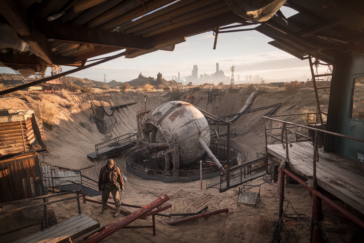
Then Fallout 3 drops you into Megaton: a junkyard town built inside a crater, wrapped around an unexploded nuclear bomb like it’s a beloved local monument. And suddenly you get what this series is really selling. Not ruins. Not retro-future kitsch. Choices that stain.
Plenty of people will argue Fallout: New Vegas has the smarter opening because it throws you into politics and factions right away. Fine. But Fallout 3 pulls a nastier trick: it turns the first “real” town into a moral pop quiz you can’t miss and don’t need a manual to understand. Bethesda, back in 2008, was clearly aiming for a bigger audience than the old-school Fallout crowd. Megaton is the pitch meeting made playable.
Megaton’s whole deal: a town that dares you to touch the bomb
The setup is blunt. Megaton exists because people decided living next to a live nuke beat dying alone in the dust. Corrugated metal shacks, catwalks, stacked homes, everything screams improvised survival. And the bomb sits there in the middle like the world’s worst fountain.
You don’t need exposition to feel the tension. The catastrophe isn’t “history” in Megaton. It’s downtown.
Then Fallout 3 does the thing that made a lot of players sit up straight: it puts the dilemma right in your lap. You can try to disarm the bomb, or you can blow the whole town to hell. No slow burn. No “maybe later.” Early game, first hub, here’s your line in the sand.
And the game ties it to its karma system and to real, visible consequences: how people treat you, what you can access, what rewards you get, what you permanently erase. It’s not a decorative “choose your dialogue tone” moment. It’s Bethesda saying: your values aren’t flavor text. They’re mechanics.
Bethesda’s sneaky tutorial: teach the player responsibility before the rules
Fallout 3’s opening hours, your childhood in the Vault, the escape, the blinding light when you step outside, are a long runway. Megaton is where Bethesda has to stick the landing: turn “training wheels” into freedom without losing the player.
So Megaton becomes a crash course in how society works when society doesn’t. There are merchants, quests, a sheriff, a weird little local religion, and a whole lot of people rationalizing the irrational because they have to. The bomb is always in your sightline, like the game is daring you to pretend it’s normal.
The karma system helps Bethesda keep the moral math simple, sometimes too simple, critics would say. But it’s effective. You do something big, the world reacts fast. You don’t have to wait 20 hours for a slideshow epilogue to learn whether you were a saint or a monster.
Disarm the bomb and you’re the fixer, the stabilizer, the person who makes this place slightly less insane. Detonate it and you’re a predator who traded a community for comfort and a payout. Either way, the game doesn’t let you wriggle out of it. The world changes, and it stays changed.
Fallout 3 vs. New Vegas: shock therapy vs. political homework
Comparing Fallout 3 and Fallout: New Vegas is a hobby at this point, and it comes down to two different philosophies.
Bethesda leads with exploration and big, readable symbols. Obsidian (with New Vegas) leads with factions, incentives, and the slow realization that everybody’s selling something.
Megaton is a billboard: here’s what you’re allowed to do in Fallout.
New Vegas is a pressure cooker: here’s what you’re going to have to understand if you want to survive.
In Fallout 3, the bomb decision is practically a personality test. In New Vegas, the early hours are more about where you fit in a messy system, who you trust, who you use, who you’re willing to prop up. Both openings can stick with you. Megaton sticks because it’s immediate and universal: protect a fragile town, or erase it for personal gain.
And because it hits before you’ve settled into the comforting lie that you’re the hero.
Why Megaton still lives rent-free in players’ heads
Megaton became a reference point because it nails three things at once: a striking image, a clear decision, and consequences that don’t evaporate.
Even the name does half the work. “Megaton” isn’t a cute frontier town label, it’s a unit of nuclear yield. The game takes that cold abstraction and turns it into a daily commute. People trade, pray, argue, and flirt a few steps from something that could wipe them off the map.
That forced coexistence, normal life pressed up against annihilation, is simple. And it’s brutal. Which is why it works.
Megaton also helped define Fallout for the mainstream audience Fallout 3 pulled in. Ask people what they remember and you’ll hear the usual icons: the Pip-Boy, the ruins, the radio tunes, and that town built around a bomb. Later games have their own memorable places, sure. But Megaton hits at the exact moment you learn what kind of person you’re willing to be when the game stops holding your hand.
FAQ: The one question everybody asks about Megaton
Why do people call Megaton the key moment in Fallout 3’s opening?
Because it introduces the series’ core promise in one shot: a nuclear bomb at the heart of a town, paired with an early moral choice that has obvious, lasting consequences. It teaches you, fast, that Fallout is going to remember what you do.