
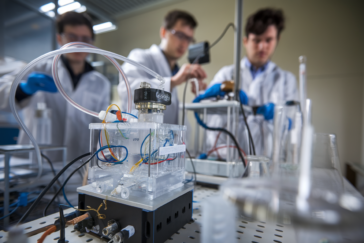
China’s latest lab gadget is a fake leaf with an attitude: shine real sunlight on it, feed it carbon dioxide and water, and it spits out carbon monoxide, an industrial workhorse molecule that can be turned into synthetic fuels.
No, it’s not a gasoline pump powered by sunshine. But it is a clever step in the long, frustrating quest to make “e-fuels” without leaning on dirty inputs that make the whole climate math look like a shell game.
A solar “charge tank” meant to stop energy from leaking away
Artificial photosynthesis has a chronic problem: light hits a material, charges separate… and then they recombine almost immediately, like a couple that swears they’re done and then texts at 2 a.m. That charge recombination bleeds efficiency.
The Chinese team’s pitch is a material that acts like acharge reservoir, a storage layer that holds solar energy as electrical charge and releases it when needed to drive chemistry. That matters for a boring reason that becomes brutally important outside the lab: the sun doesn’t run on an industrial schedule. Factories do.
The catch: the source description doesn’t give the numbers journalists (and investors) live for, conversion efficiency, how long the charge can be stored, how performance holds up after long runs. Without that, you can’t honestly stack it up against the best academic systems already out there.
Why carbon monoxide is the “first brick” toward synthetic gasoline
The device’s headline reaction is converting carbon dioxide (CO₂) into carbon monoxide (CO). That sounds like swapping one toxic gas for another, and, sure, CO is dangerous. But in chemical manufacturing, CO is a prized intermediate.
Pair CO with hydrogen and you get “syngas,” the feedstock for old-school industrial routes to liquid fuels. The best-known is Fischer–Tropsch synthesis, which can build longer hydrocarbon chains that refineries know how to finish into diesel, jet fuel, and other liquids. Another pathway runs through methanol and then into gasoline-range products.
There’s a reason researchers aim for CO instead of trying to crank out ready-to-burn fuel directly: making complex hydrocarbons in one photochemical leap is a control nightmare. CO is simpler, easier to measure, and easier to optimize for selectivity and catalyst stability. The downside is obvious, every extra step after CO costs energy, and those losses add up fast.
The big claim: no “sacrificial” chemicals, just water as the electron source
Plenty of artificial-photosynthesis demos quietly rely on so-called “sacrificial” reagents, chemicals that get consumed to keep the reaction going or to prevent charge recombination. They can make lab results look great, and they also create waste and distort the environmental ledger.
This team says it avoids that, using water as the electron donor, closer to what plants do. That’s a meaningful claim because water oxidation is hard: it demands tough catalysts and careful electrochemistry, and many systems degrade over time.
Again, the missing details matter. The source text doesn’t spell out whether oxygen is produced (as you’d expect when splitting water), how product separation is handled, or what safety controls look like. Those aren’t footnotes; they’re the difference between a neat paper and a pilot plant that doesn’t blow up or foul itself into uselessness.
Real sunlight helps the credibility, industry will still demand brutal proof
One thing the researchers did right: they say the system runs under natural sunlight, not just under pampered lab lamps. That closes a common credibility gap. But “works in sunlight” is the start of the argument, not the end.
Scaling this kind of chemistry runs into the same brick walls every time. Capturing CO₂ is easier from a smokestack than from open air, where it’s dilute. Then you’ve got gas handling, purification, compression, water management, catalyst poisoning, UV damage, thermal cycling, the unglamorous stuff that kills prototypes.
And there’s competition. A lot of the world is already betting on a more straightforward chain: renewable electricity → electrolyzers make hydrogen → combine hydrogen with captured CO₂ to make fuels. A direct sunlight-driven route would need to beat, or at least complement, that on cost and efficiency. Without hard performance numbers, this Chinese “charge tank” approach reads as a promising lab tactic for dealing with intermittency and avoiding sacrificial additives, not a refinery replacement.
If the charge-reservoir idea holds up, it could influence other photoelectrochemical systems beyond fuels, basic chemical feedstocks, for example. But the real test is the one that always separates science fair from industry: can it run for hundreds or thousands of hours, cheaply, with dirty real-world inputs, and produce a measurable amount of useful product per square yard of reactor?