
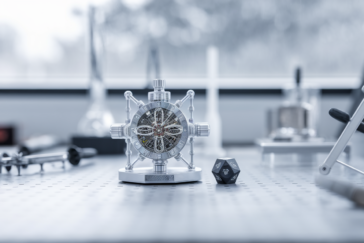
China is bragging it’s built anatomic clock smaller than a die, the kind of tiny, high-precision timekeeper that could ride inside drones and keep them on course when GPS goes dark.
Sounds nerdy. It isn’t. In modern warfare, and increasingly in civilian infrastructure,time is power. If you can keep perfect time without outside help, you can navigate, coordinate sensors, and run networks even when someone’s trying to blind you with jamming or spoofing.
Beijing hasn’t released the juicy stuff: the exact design, hard performance numbers, or when (or whether) this thing hits mass production. But the direction is obvious. Every major tech power is chasingcompact atomic clocksso systems can keep functioning when satellite navigation signals are weak, missing, or untrustworthy.
A dice-sized atomic clock: why shrinking it actually matters
When most Americans hear “atomic clock,” they picture a lab cabinet with warning labels. Reality check: there are already smaller, ruggedized versions for specialized uses. But “smaller than a die” is a different flex, this is the extreme end of miniaturization, where every millimeter and every watt counts.
The point isn’t cute engineering. It’s physics and logistics:weight, volume, heat, and power drawdecide what a drone, missile, satellite, or remote sensor can carry. If you can cram a stable frequency reference into something pocket-sized, you can push high-end timing into platforms that used to be too small, or too disposable, to justify it.
Atomic clocks work by locking onto an atomic transition to generate an ultra-stable frequency. Stable frequency means stable time. And stable time turns into real-world capability: tighter synchronization between sensors, better timestamping, cleaner data fusion, and, crucially for navigation, better position estimates because distance calculations depend on timing.
But miniaturization is where the engineering knife fight starts. Smaller devices usually mean less power, worse thermal isolation, and a harder job keeping sensitive components in a stable environment. Then add vibration, shock, temperature swings, and electromagnetic noise, the stuff drones live with every day. A tiny atomic clock only matters if it stays stable in that mess.
Why combat drones want atomic-grade timing
The article’s not subtle about the target use case:combat drones. And “precision” here isn’t just about hitting a target. It’s about knowing where you are, keeping formation, syncing sensors, and operating in a contested environment where the other side is actively trying to mess with your electronics.
Modern drones lean heavily on satellite navigation, GPS for the U.S., BeiDou for China, Galileo for Europe, GLONASS for Russia. The dirty secret: those signals are faint by the time they reach the ground, which makes themeasy to jamand sometimes easier than you’d like to spoof.
A high-quality onboard atomic clock lets a drone hold an internal time reference longer without “checking in” with satellites. That supports inertial or hybrid navigation, using internal sensors with occasional updates, so when jamming hits, the drone doesn’t instantly turn into an expensive lawn dart. The slower the clock drifts, the longer the platform can keep estimating position and coordinating actions.
Timing also underpins coordination: multi-drone operations, sensor fusion, frequency-hopping comms, and tactical networks all depend on precise timestamps. If your time base slips, you can get misaligned sensor data, degraded radar imaging, or target-tracking errors that cascade fast.
And here’s the strategic kicker: if you can make these clocks small and manufacturable, you can spread them across lots of systems, including “attritable” drones designed to be lost. That’s a very different world than a few exquisite platforms with boutique components.
The bigger race: navigation that doesn’t collapse when satellites get sketchy
This isn’t a China-only obsession. The U.S. and its allies have been pouring money into “GPS-denied” capability for years, because jamming and spoofing incidents keep piling up, not only in war zones, but also in civilian aviation and maritime environments where interference has been repeatedly reported by authorities.
Compact atomic clocks are one pillar of resilience, alongside inertial navigation systems, terrain mapping, “signals of opportunity” (using ambient radio sources), and terrestrial positioning backups. The logic is simple: when the external reference disappears, a strong internal clock helps keep the whole system coherent longer.
There’s also a sovereignty angle. If you control your own time-and-frequency tech stack, you’re less dependent on foreign suppliers for components that matter to defense, telecom, critical infrastructure, and precision measurement. China’s announcement fits its broader push to climb the tech ladder and build domestic alternatives under tightening export controls.
Still, anyone who’s covered defense tech for a living knows the drill: press releases love size because it’s easy to visualize. Operators care about the boring charts, stability, drift over time, temperature performance, vibration tolerance, power consumption, and lifespan.
From lab demo to real-world hardware: power, integration, and export-control headaches
Even if the device exists exactly as advertised, turning it into something fielded is a grind. It has to be packaged, protected, powered, calibrated, and integrated with onboard electronics without turning the drone into a flying EMI problem.
Power is the tax collector here. Drones live on tight energy budgets. Add a component that draws too much, and you either cut endurance or add battery weight, both painful. Shrinking a device doesn’t automatically mean it sips power, but it can reduce heating and support electronics if the design is smart.
Then there’s manufacturing reality: precision devices are hard to mass-produce with consistent quality. And timing tech is often treated asdual-use, civilian on paper, military in practice, so export controls and supply-chain restrictions can get involved fast.
The bottom line: “smaller than a die” is a headline. The real proof will be performance data and, eventually, sightings in actual systems, contracts, prototypes on platforms, and demonstrations where the clock keeps its cool under vibration, temperature swings, and electronic attack.