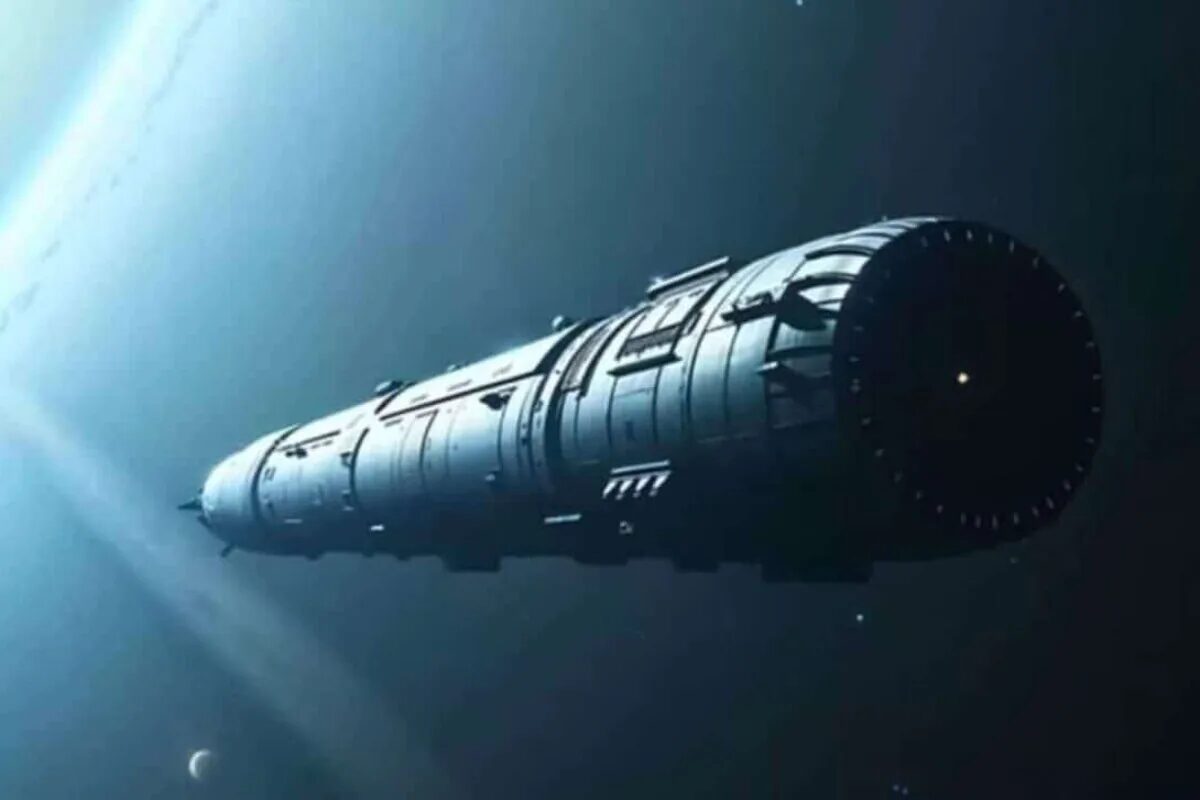
Picture a spaceship so long it makes Manhattan look like a keychain, and a mission plan so blunt it doesn’t bother with the usual sci-fi fantasy of heroic homecomings.
The concept is calledChrysalis: a58-kilometerinterstellar vessel, about36 miles, designed to carry1,000 humanson a250-yeartrip to another star. And the selling point is the part most space pitches try to hide in the fine print:there’s no return ticket.
This isn’t a “let’s go take a look” mission. It’s an ark. A flying, sealed-off mini-civilization that leaves Earth behind for good and hands the destination to people who haven’t been born yet.
A colony with engines, not a vehicle with passengers
Chrysalis was cooked up as part of an interstellar mission design competition, with a team straddling research and design. The premise is simple and brutal: keeping1,000 peoplealive fortwo and a half centurieslooks a lot less like “spaceflight” and a lot more like running a small town, except your town can’t import food, call FEMA, or vote to move somewhere else.
That flips the usual space-mission priorities. For a capsule or a short-duration habitat, you squeeze mass, power, and volume until everyone’s miserable, then you tell them to suck it up for a few weeks or months. For Chrysalis, chronic misery isn’t “character-building.” It’s a public-health problem and a political time bomb. Overthree or four generations, a bad social design can do more damage than a busted valve.
And the “no return” part isn’t just edgy branding, it’s internal logic. If the trip takes250 years, the original crew is never going home in any meaningful sense anyway. Chrysalis just says the quiet part out loud: if survival is the goal, what do you give up on day one to make a closed society last longer than any human life?
Artificial gravity: the “nice-to-have” that turns into a requirement
The heart of the concept is a rotating habitat ring, spin the structure, use centrifugal force to press people “down,” and you get artificial gravity. Not for comfort. For biology.
We already know what long stretches in microgravity do: bone density drops, muscles waste, cardiovascular systems change. Astronauts on the International Space Station typically do6 to 12 monthsand come back with aggressive rehab plans. Now stretch that to250 yearsand imagine an entire population living in permanent physical decline. That’s not a mission; that’s a slow-motion medical emergency.
The headline length,36 miles, isn’t just a flex. Bigger rings can spin slower to produce Earth-like gravity, which reduces two nasty side effects: motion sickness from rotation and the weird “gravity gradient” where your feet feel heavier than your head. In a ship carrying1,000 people, those aren’t nerdy engineering footnotes. They’re public health policy.
A sealed ecosystem: grow, recycle, repeat, forever
You can’t pack 250 years of groceries. The mass alone would be laughable. So Chrysalis leans on a closed-loop ecosystem: grow food, recycle water, scrub and replenish air, keep the whole thing balanced for centuries.
Agriculture becomes the beating heart of the ship. The concept points tovertical farms, stacked growing systems with controlled lighting, so plants can grow continuously. And in a closed habitat, the salad isn’t just dinner; it’s part of your life-support spreadsheet. Food production and oxygen production become the same problem.
Here’s the catch: closed ecosystems hate improvisation. A crop disease, a microbial imbalance, or a months-long dip in yields can snowball into a shipwide crisis. Everything has to be redundant, monitored, and fixable with what you’ve got on board.
And that’s the part space fans tend to skip: “self-sufficient” doesn’t just mean supplies. It meansskills. Overfour generations, how do you make sure the ship never runs out of competent farmers, mechanics, doctors, and teachers, without an Earth-based team to troubleshoot and ship replacement parts?
On a six-month mission, waste is annoying. On a 250-year mission, waste is a debt that compounds until it kills you.
Life onboard: 1,000 people trapped in the same argument for centuries
Six astronauts can be managed with checklists, chain of command, and a lot of mission control. A community of1,000needs something messier: laws, schools, family life, privacy, conflict resolution, and a culture that doesn’t tear itself apart when things get tight.
The number1,000is doing a lot of work here. It’s large enough to aim for genetic and professional diversity, and small enough that every crisis hits everybody fast. An outbreak, a shortage, a political decision that half the ship hates, there’s no “other city” to flee to. It’s all one boat.
Then there’s the psychological gut-punch of “no return.” On normal missions, Earth is the anchor: the authority, the fallback, the place you’ll see again. On Chrysalis, Earth becomes a story your grandparents told you. The destination belongs to your descendants. That’s not a philosophy seminar; it’s a motivation problem. If people stop believing in the project, the ship doesn’t need an asteroid to fail, it can collapse from the inside.
At 36 miles long, engineering turns into a 250-year maintenance nightmare
A ship this big forces a different kind of engineering humility. Systems don’t just have to work, they have to be maintainable for250 years. On Earth, we replace major infrastructure every30 to 50 yearsif we’re being responsible. In deep space, you don’t “order the part.” You don’t limp back to port.
Every technical choice becomes a bet against time: materials age, components fatigue, and design mistakes get paid back with interest when they repeat for two centuries. Even redundancy has limits, two copies of the same system can fail the same way for the same reasons.
So the concept quietly demands something bigger than a ship: an onboard industrial base. You need workshops, recycling, fabrication, training, an ability to remake what breaks. A little ISS-style tool bench won’t cut it overthree generations. At that point, the line between “spacecraft” and “colony” evaporates.
And the rotating habitat that makes gravity possible also adds a constant mechanical stressor. Keeping a spinning structure healthy for250 yearsmeans permanent access to critical areas, procedures that survive cultural drift, and safety margins that assume humans will eventually get complacent, because humans always do.
What Chrysalis really says about us
Chrysalis isn’t a funded NASA program or a launch-ready blueprint. It’s a concept. But it’s a concept with three numbers that hit like a barstool punchline:36 miles,1,000 people,250 years.
Put them together and space stops looking like a series of daring road trips and starts looking like something harsher: permanent separation. A branch of humanity cut loose from Earth, building its own rules and its own memory in a sealed can.
Would we ever actually send1,000 peopleon a one-way, multi-century ride? Maybe. Or maybe projects like this exist to force the uncomfortable realization that the hardest part of deep space isn’t the rocket equation, it’s keeping a society functional when there’s no rescue, no resupply, and no exit.