NASA’s next rover might not roll. It might trot.
After decades of sending slow, heavy, wheel-on-rock contraptions across alien dirt, the agency is leaning into something that looks a lot more like a mechanical mutt: a 4-legged, ultra-compact explorer designed to climb, scramble, and keep moving when wheels would just spin and sulk.
The program is called LEAP, Legged Exploration of Alien Planets, and it’s being built around a blunt idea: Mars and the Moon don’t care that wheels worked fine in the parking lot.
From 1,982-pound behemoths to 110-pound climbers
Curiosity weighs about899 kg, roughly1,982 pounds. That’s a small car. It’s also a small car that can’t hop a ledge, can’t step over a trench, and can’t do much when the terrain turns into a mess of boulders and steep slopes.
LEAP’s quadrupeds, by contrast, are built in the50 kgrange, about110 pounds. NASA’s Jet Propulsion Laboratory is working with specialized startups, and the current test machines are derived from Boston Dynamics’Spotplatform. The pitch: animal-style mobility for places where wheels become a liability.
NASA is putting real money behind it:$180 millionover three years, with the goal of flying operational prototypes onArtemis IV and Artemis V, targeted for2028–2030.
Boston Dynamics-style prototypes are already clearing 2-foot obstacles
SinceSeptember 2025, NASA has been testingfourprototypes at theJohnson Space Center. The numbers are the kind that make traditional rover engineers wince:
These legged bots are stepping over obstacles up to60 cm, about24 inches, and handling slopes of35 degrees. A wheeled rover’s low center of gravity and rigid wheel geometry are great until they aren’t. And on the Moon or Mars, “aren’t” shows up fast.
you can’t just slap a space sticker on a warehouse robot and call it a day. No atmosphere, brutal temperature swings, everything from cooling to lubrication has to be rethought. The teams reportedly builtpassive radiatorsinto the legs themselves, dumping heat without burning extra power. That’s the kind of unsexy engineering that actually makes missions work.
Power is still the choke point, so they’re packing bigger batteries
Each robot is slated to carry a12 kWh lithium-ion battery, plus flexible next-gen solar panels. NASA’s target:14 daysof continuous autonomy, compared with roughly5 to 7 daysfor today’s rovers.
In lab simulations that mimic Mars gravity, about38%of Earth’s, the prototypes hit4.2 km/h, around2.6 mph. That’s reportedly about double the top performance ofPerseverance. No, it’s not a drag race. But speed matters when you’re trying to cover ground before dust, cold, and time chew up your schedule.
SpaceX wants to ship a whole “pack” in a modified Dragon capsule
The other big shift here isn’t just legs, it’s philosophy.
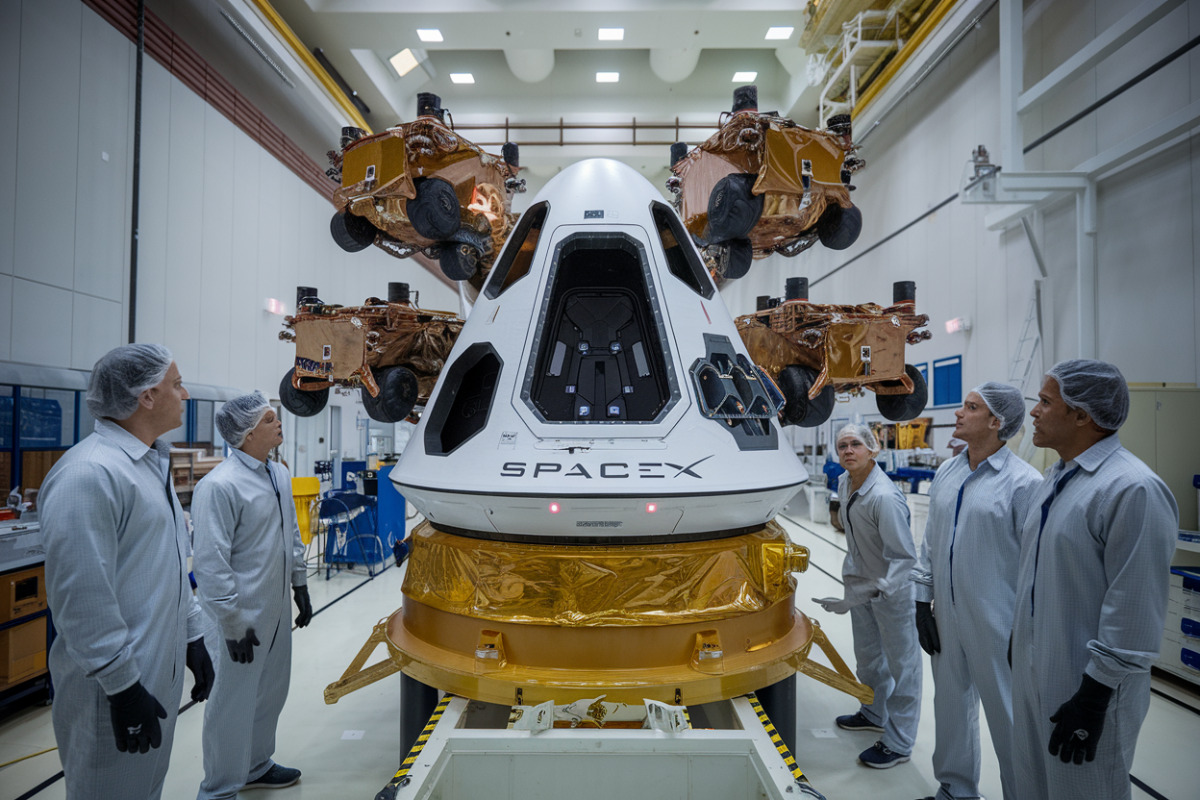
Instead of betting the mission on one giant rover,SpaceXis said to be modifying itsDragoncapsule to carry up tosixof these quadrupeds at once. That’s a very different kind of risk management: lose one robot, you don’t lose the whole mission.
The Dragon changes reportedly include automated deployment hardware and beefed-up protective shells. Each rover would run its own landing sequence, allowing controlled dispersal across a radius of50 km, about31 miles. One rover maps one patch; six rovers can chew through a region.
Smarter robots, fewer “Mother, may I?” messages back to Earth
Autonomy is where NASA’s trying to stop playing catch-up with physics. Mars is far enough away that communications can lag by about14 minutes. If your rover needs permission to do everything, it spends a lot of its life waiting.
Each quadruped is expected to carry anNvidia Jetson AGX Orinfor real-time vision and lidar processing. The idea is local decision-making: recognize interesting geology, pick routes, and adjust plans without a human babysitter.
JPL projections claim this could boost scientific efficiency by a factor often. Big claim. But the direction is right: if you want more science per day, you stop treating the rover like a remote-control toy.
And because there are multiple robots, they’ll reportedly talk to each other over a low-power mesh network, sharing discoveries and building a more complete map together. Add360-degree stereo vision, and you’ve got machines that can “see” trouble coming from more than just straight ahead, another quiet advantage over the current generation.
First target: Shackleton Crater, October 2028
The first real outing is planned forShackleton Craternear the Moon’s south pole inOctober 2028. If you’re not a lunar nerd: Shackleton is one of the places everyone circles when they talk about future human bases, because permanently shadowed regions nearby may holdwater ice.
Those shadow zones are exactly where solar-powered wheeled rovers start to look like a bad joke. The quadrupeds are meant to push into the darkness and help map ice deposits with the kind of detail planners will demand before they park astronauts there.
NASA’s treating the Moon as the proving ground before sending the pack to Mars, with a Mars push penciled in for2030. Artemis IV’s six rovers are tasked with collecting and analyzing200lunar regolith samples overthree months, a high-volume sampling campaign designed to steer where future habitats get built.
If they pull it off, the era of the lonely rover crawling across a planet might finally give way to something smarter: a coordinated swarm that can climb, scout, and fail gracefully.